Monday, March 18, 2019

The Fourth Sunday in Lent (C), March 31, 2019 - Joshua 5:9-12 and 2 Corinthians 5:16-21 and Luke 15:1-3, 11b-32


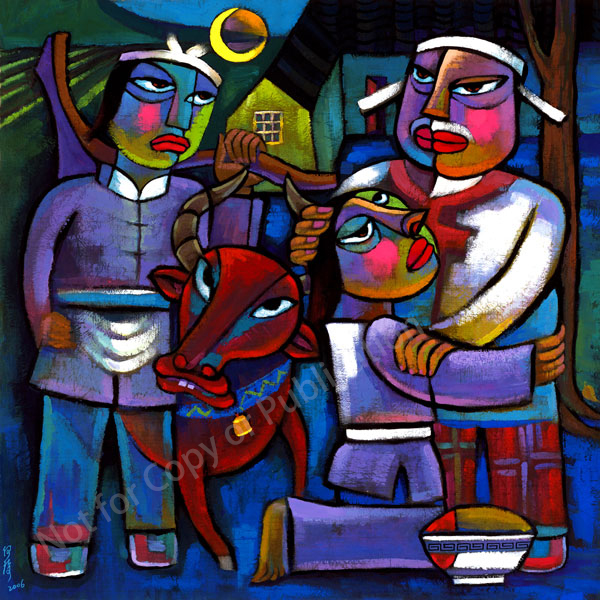
He Qi: Prodigal Son
in "The Art of He Qi”

Joshua 5:9-12 (vss. 1-8 added at the end to show more of the context)
  
Meal on the Plains of Jericho

It doesn’t say just what was the disgrace
Of Egypt that the LORD then rolled away;
But it’s implied the social status of
Ancestral slaves would be no more conveyed -

Life now was new, for what was past, was past!
It meant the parents’ tragedies were gone,
And would no more define just who they were -
Which well we know’s more eas’ly said than done.


And thus, the sons and grandsons of those slaves
Were circumcised so all would surely know
They were the LORD’s! They’d hold their heads up high;
In confidence, the LORD who saves, they’d show.

It meant the manna was no more, because
The people now could stand on their two feet;
The passover they kept that day declared
No other god can with the LORD compete.

Scott L. Barton

(When all the kings of the Amorites beyond the Jordan to the west, and all the kings of the Canaanites by the sea, heard that the Lord had dried up the waters of the Jordan for the Israelites until they had crossed over, their hearts melted, and there was no longer any spirit in them, because of the Israelites.

At that time the Lord said to Joshua, “Make flint knives and circumcise the Israelites a second time.” So Joshua made flint knives, and circumcised the Israelites at Gibeath-haaraloth. This is the reason why Joshua circumcised them: all the males of the people who came out of Egypt, all the warriors, had died during the journey through the wilderness after they had come out of Egypt. Although all the people who came out had been circumcised, yet all the people born on the journey through the wilderness after they had come out of Egypt had not been circumcised. For the Israelites traveled forty years in the wilderness, until all the nation, the warriors who came out of Egypt, perished, not having listened to the voice of the Lord. To them the Lord swore that he would not let them see the land that he had sworn to their ancestors to give us, a land flowing with milk and honey. So it was their children, whom he raised up in their place, that Joshua circumcised; for they were uncircumcised, because they had not been circumcised on the way. When the circumcising of all the nation was done, they remained in their places in the camp until they were healed.)

The Lord said to Joshua, “Today I have rolled away from you the disgrace of Egypt.” And so that place is called Gilgal to this day.

While the Israelites were camped in Gilgal they kept the passover in the evening on the fourteenth day of the month in the plains of Jericho. On the day after the passover, on that very day, they ate the produce of the land, unleavened cakes and parched grain. The manna ceased on the day they ate the produce of the land, and the Israelites no longer had manna; they ate the crops of the land of Canaan that year.

+ + +

2 Corinthians 5:16-21

Meeting with the Pastor Nominating Committee

Jeff Curtis asked me in the interview
Which verse of scripture meant the most to me;
I said the one where everything is new,
And where, in Christ, we're from the past set free. 

What made this verse pop then into my head - 
One I believed, but never called it “best?”
Perhaps in worship, I had often said
Those words, which now, in being asked, expressed.

The “old” means when you think you have it planned,
A place for everything, all in its place;
Out of the blue, then, on the other hand,
God's newness will be right before your face. 

Paul calls us to be reconciled to God,
That is, be acclimated to the news
Which, in our daily life, we find quite odd:
You cannot stop the love which God pursues.

Scott L. Barton
(2016)

From now on, therefore, we regard no one from a human point of view; even though we once knew Christ from a human point of view, we know him no longer in that way. So if anyone is in Christ, there is a new creation: everything old has passed away; see, everything has become new! All this is from God, who reconciled us to himself through Christ, and has given us the ministry of reconciliation; that is, in Christ God was reconciling the world to himself, not counting their trespasses against them, and entrusting the message of reconciliation to us. So we are ambassadors for Christ, since God is making his appeal through us; we entreat you on behalf of Christ, be reconciled to God. For our sake he made him to be sin who knew no sin, so that in him we might become the righteousness of God.

+  +  +
  
Luke 15:1-3, 11b-32

Prodigal Son, Prodigal Dad

Prodigal son, prodigal dad,
I call him that because he's glad!
To say it as might Dr. Seuss,
Son 1 thought 2 had cooked his goose!
And then begrudged the fatted calf
Was cooked instead! It makes me laugh
To know that Jesus with a smile
Knew God, the Dad, the extra mile
Goes, falling on the neck to kiss
Each son or daughter whom he's missed.

Scott L. Barton
(2013)

Now all the tax collectors and sinners were coming near to listen to him. And the Pharisees and the scribes were grumbling and saying, “This fellow welcomes sinners and eats with them.” So he told them this parable:

“There was a man who had two sons. The younger of them said to his father, ‘Father, give me the share of the property that will belong to me.’ So he divided his property between them. A few days later the younger son gathered all he had and traveled to a distant country, and there he squandered his property in dissolute living. When he had spent everything, a severe famine took place throughout that country, and he began to be in need. So he went and hired himself out to one of the citizens of that country, who sent him to his fields to feed the pigs. He would gladly have filled himself with the pods that the pigs were eating; and no one gave him anything. But when he came to himself he said, ‘How many of my father’s hired hands have bread enough and to spare, but here I am dying of hunger! I will get up and go to my father, and I will say to him, “Father, I have sinned against heaven and before you; I am no longer worthy to be called your son; treat me like one of your hired hands.”’ So he set off and went to his father. But while he was still far off, his father saw him and was filled with compassion; he ran and put his arms around him and kissed him.Then the son said to him, ‘Father, I have sinned against heaven and before you; I am no longer worthy to be called your son.’ But the father said to his slaves, ‘Quickly, bring out a robe—the best one—and put it on him; put a ring on his finger and sandals on his feet. And get the fatted calf and kill it, and let us eat and celebrate; for this son of mine was dead and is alive again; he was lost and is found!’ And they began to celebrate. “Now his elder son was in the field; and when he came and approached the house, he heard music and dancing. He called one of the slaves and asked what was going on. He replied, ‘Your brother has come, and your father has killed the fatted calf, because he has got him back safe and sound.’ Then he became angry and refused to go in. His father came out and began to plead with him. But he answered his father, ‘Listen! For all these years I have been working like a slave for you, and I have never disobeyed your command; yet you have never given me even a young goat so that I might celebrate with my friends.But when this son of yours came back, who has devoured your property with prostitutes, you killed the fatted calf for him!’ Then the father said to him, ‘Son, you are always with me, and all that is mine is yours. But we had to celebrate and rejoice, because this brother of yours was dead and has come to life; he was lost and has been found.’”

Sunday, March 10, 2019

The Third Sunday in Lent (C), March 24, 2019 - Isaiah 55:1-9 and Luke 13:1-9


Isaiah 55:1-9


The poem is a rendering of the Isaiah text. Click on the image above for the hymn, put to the tune, MELITA (“Eternal Father, Strong to Save”). The last two lines of the poem below are the refrain for every verse of the hymn. Free for congregational use, formatted to be printed on 8.5x11 bulletin insert paper (sideways, two per sheet).

For Heaven's Sake

Ho, everyone who thirsts, come drink,
Though you be poor, come now and eat!
With all your money, do you think
Your spending makes your life complete?

Just listen up, and you will see
The food that's good which I will give;
Incline your ear and come to me,
Filled with delight, so you will live!

My steadfast love for David shows
My love for you will never end,
And people everywhere will know
You're blessed, and run, and you befriend.

Now seek, so that the  LORD, you find,
Forsake the wrong in mind and deed,
Because the LORD is always kind,
And pardons all who come in need.

I'm not like you in thoughts and ways,
For heav'n's sake, I'll never stray.

Scott L. Barton

Ho, everyone who thirsts, come to the waters; 
and you that have no money, come, buy and eat! 
Come, buy wine and milk without money and without price. 
Why do you spend your money for that which is not bread, 
and your labor for that which does not satisfy? 
Listen carefully to me, and eat what is good, 
and delight yourselves in rich food. 
Incline your ear, and come to me; listen, so that you may live. 
I will make with you an everlasting covenant, 
my steadfast, sure love for David. 
See, I made him a witness to the peoples, 
a leader and commander for the peoples. 
See, you shall call nations that you do not know, 
and nations that do not know you shall run to you, 
because of the Lord your God, the Holy One of Israel,
for he has glorified you.
Seek the Lord while he may be found, 
call upon him while he is near; 
let the wicked forsake their way, 
and the unrighteous their thoughts; 
let them return to the Lord, that he may have mercy on them, 
and to our God, for he will abundantly pardon. 
For my thoughts are not your thoughts, 
nor are your ways my ways, says the Lord. 
For as the heavens are higher than the earth, 
so are my ways higher than your ways 
and my thoughts than your thoughts.


+ + +

Luke 13:1-9


Fig Tree

I think, perhaps, we miss the point
If we think God condoned
The cutting of that fig tree which
The vineyard grower owned;
For note the gard'ner said to him,
"Then YOU can cut it down;"
He must have said it with a grin,
And not some judgment frown,
Since first, the owner'd said to him
That HE should do the deed;
But Jesus' gard'ner knew the owner's
Nature supersedes
The "Fix yourself right now - or else"
View we think others need;
Thus, we can cut some slack for all,
Since God's love none exceeds.

Scott L. Barton
(2013)

At that very time there were some present who told him about the Galileans whose blood Pilate had mingled with their sacrifices. He asked them, “Do you think that because these Galileans suffered in this way they were worse sinners than all other Galileans? No, I tell you; but unless you repent, you will all perish as they did. Or those eighteen who were killed when the tower of Siloam fell on them—do you think that they were worse offenders than all the others living in Jerusalem? No, I tell you; but unless you repent, you will all perish just as they did.”

Then he told this parable: “A man had a fig tree planted in his vineyard; and he came looking for fruit on it and found none. So he said to the gardener, ‘See here! For three years I have come looking for fruit on this fig tree, and still I find none. Cut it down! Why should it be wasting the soil?’ He replied, ‘Sir, let it alone for one more year, until I dig around it and put manure on it. If it bears fruit next year, well and good; but if not, you can cut it down.’”


https://mail.google.com/mail/u/0/images/cleardot.gif


Tuesday, March 5, 2019

The Second Sunday in Lent (C), March 17, 2019 - Philippians 3:17-4:1; Genesis 15:1-12, 17-18; and Luke 13:31-35

He Qi: Look Towards the Heavens
(from his book, "The Art of He Qi")
Philippians 3:17-4:1
 
Tactic

I like how Paul
Calls them his joy and crown;
A better move
Than saying, “Settle down.”

Scott L. Barton

Brothers and sisters, join in imitating me, and observe those who live according to the example you have in us. For many live as enemies of the cross of Christ; I have often told you of them, and now I tell you even with tears. Their end is destruction; their god is the belly; and their glory is in their shame; their minds are set on earthly things. But our citizenship is in heaven, and it is from there that we are expecting a Savior, the Lord Jesus Christ. He will transform the body of our humiliation that it may be conformed to the body of his glory, by the power that also enables him to make all things subject to himself.

Therefore, my brothers and sisters, whom I love and long for, my joy and crown, stand firm in the Lord in this way, my beloved.

+  +  +

Genesis 15:1-12, 17-18

The Big Delay

Oh, why did Abraham believe,
When God said, what was up God's sleeve,
Was Abraham would have an heir -
And of the promise, had a prayer?
It's so important here to see
The promise long-delayed as key
To what this text to us declares:
That Abram's yearning now compares 
To all our hopes for justice, peace,
While faith, though questioning, not cease.
The stars, God's generosity, declare,
And still, unceasing love, God dares.
There's still a vision for this time,
It speaks of peace, and does not lie,
If it seems long, we still need wait,
For come it will, and not be late.

Scott L. Barton
(2016)

(The concluding four lines is the message of Habakkuk 2:3. Remember that this Gen. 15 promise of God's to Abram wasn't the first; it was given way back in chapter 12 and by chapter 15 still has not appeared. So Abram questions God, wondering if God really, really meant it. Holding in tension that problem of unresolved promise is always the nature of this faith of ours. But "standin' on the promises," as the old hymn goes, is the only way to live and so invite such promise into being.)

After these things the word of the Lord came to Abram in a vision, “Do not be afraid, Abram, I am your shield; your reward shall be very great.”

But Abram said, “O Lord God, what will you give me, for I continue childless, and the heir of my house is Eliezer of Damascus?” And Abram said, “You have given me no offspring, and so a slave born in my house is to be my heir.” But the word of the Lord came to him, “This man shall not be your heir; no one but your very own issue shall be your heir.” He brought him outside and said, “Look toward heaven and count the stars, if you are able to count them.” Then he said to him, “So shall your descendants be.” And he believed the Lord; and the Lord reckoned it to him as righteousness.

Then he said to him, “I am the Lord who brought you from Ur of the Chaldeans, to give you this land to possess.” But he said, “O Lord God, how am I to know that I shall possess it?” He said to him, “Bring me a heifer three years old, a female goat three years old, a ram three years old, a turtledove, and a young pigeon.” He brought him all these and cut them in two, laying each half over against the other; but he did not cut the birds in two. And when birds of prey came down on the carcasses, Abram drove them away.

As the sun was going down, a deep sleep fell upon Abram, and a deep and terrifying darkness descended upon him.

When the sun had gone down and it was dark, a smoking fire pot and a flaming torch passed between these pieces. On that day the Lord made a covenant with Abram, saying, “To your descendants I give this land, from the river of Egypt to the great river, the river Euphrates,”

+ + +

Luke 13:31-35

Blessing

It has been said that fear, not sin's
The curse of human life,
It surely seems that that's behind
The things that cause my strife;
And so it was, those Pharisees,
Who said to Jesus, "Scram!"
Were worried that his love, unchecked,
Would make their city damned
By Herod, since he was, all knew,
The ruling King of Fear;
But Jesus said to tell that fox
What we still need to hear,
That is, that resurrection is the end
("The third day" is his clue)
And what I think that means, when by
Our fears we seem pursued,
Is that the mother hen still calls
Her brood upon her breast,
So all our fears, allayed, we now
Might bless, as we are blessed.

Scott L. Barton
(2013)


At that very hour some Pharisees came and said to him, “Get away from here, for Herod wants to kill you.” He said to them, “Go and tell that fox for me, ‘Listen, I am casting out demons and performing cures today and tomorrow, and on the third day I finish my work. Yet today, tomorrow, and the next day I must be on my way, because it is impossible for a prophet to be killed outside of Jerusalem.’ Jerusalem, Jerusalem, the city that kills the prophets and stones those who are sent to it! How often have I desired to gather your children together as a hen gathers her brood under her wings, and you were not willing! See, your house is left to you. And I tell you, you will not see me until the time comes when you say, ‘Blessed is the one who comes in the name of the Lord.’”

Tuesday, February 26, 2019

The First Sunday in Lent (C), March 10, 2019 - Romans 10:8b-13; and Deuteronomy 26:1-11; and Luke 4:1-13


These Syrian refugees make me think of the phrase,
"A wandering Aramean was my ancestor"


Romans 10:8b-13

What Does It Say?

It seems to me Paul doesn’t say
That only those who say these words
Will see salvation come one day,
As if it’s something they deserve.

It’s clear he simply reassured
Those worried they’d not done enough
For blessings that are now ensured
By Christ, who all our fears rebuffs.

Is it enough to feed the poor,
Or must I do - or have - it all?
Is it enough God’s love endures,
Or must I all life’s ills forestall?

What does it say? Christ demonstrates
To need, and simply know you need
You never ought to underrate:
When knowing you’re no god, you’re freed.

Scott L. Barton

But what does it say? “The word is near you, on your lips and in your heart” (that is, the word of faith that we proclaim); because if you confess with your lips that Jesus is Lord and believe in your heart that God raised him from the dead, you will be saved. For one believes with the heart and so is justified, and one confesses with the mouth and so is saved. The scripture says, “No one who believes in him will be put to shame.”

For there is no distinction between Jew and Greek; the same Lord is Lord of all and is generous to all who call on him. For, “Everyone who calls on the name of the Lord shall be saved.”


+ + +

Deuteronomy 26:1-11

Why Go to Church?

Our forebears knew how great their need
To say their thanks with such a creed
As this, reflecting whence they came.
They gave their ancestors a name:
Not smarter or more powerful 
Than those who sheared them for their wool;
Not self-reliant, needing none,
When by themselves they'd been outdone;
Not conqu'ring heroes who were pure,
And strangers made them insecure;
Not brave, or strong, or hardy stock,
But "wandering!" - like some lost flock
Where someone had to show the way!
That someone was the LORD, portrayed
By how they thanked; and still it's true,
And still why we should sit in pews.

Scott L. Barton
(2016)

When you have come into the land that the Lord your God is giving you as an inheritance to possess, and you possess it, and settle in it, you shall take some of the first of all the fruit of the ground, which you harvest from the land that the Lord your God is giving you, and you shall put it in a basket and go to the place that the Lord your God will choose as a dwelling for his name. You shall go to the priest who is in office at that time, and say to him, “Today I declare to the Lord your God that I have come into the land that the Lord swore to our ancestors to give us.” When the priest takes the basket from your hand and sets it down before the altar of the Lord your God, you shall make this response before the Lordyour God: “A wandering Aramean was my ancestor; he went down into Egypt and lived there as an alien, few in number, and there he became a great nation, mighty and populous. When the Egyptians treated us harshly and afflicted us, by imposing hard labor on us, we cried to the Lord, the God of our ancestors; the Lord heard our voice and saw our affliction, our toil, and our oppression. The Lord brought us out of Egypt with a mighty hand and an outstretched arm, with a terrifying display of power, and with signs and wonders; and he brought us into this place and gave us this land, a land flowing with milk and honey. So now I bring the first of the fruit of the ground that you, O Lord, have given me.” You shall set it down before the Lord your God and bow down before the Lord your God. Then you, together with the Levites and the aliens who reside among you, shall celebrate with all the bounty that the Lord your God has given to you and to your house.

+ + +

Luke 4:1-13

Who’s That Knocking at My Door?

"He departed from him until an opportune time.”
What a strange line.
We assume Luke meant the Garden of Gethsemane;
But we only have the story's bare bones, after all.
What if the devil chose other times that we just don't know about?
"Opportunity knocks," we say;
And maybe the devil does, too.
As maybe he did for Jesus.
But, "Behold, I stand at the door and knock," John writes later.
So when I hear it, I say, "Who's that knocking at my door?
"Is it the devil - or the Lord?"
Maybe Luke knew it's never an easy question,
Even for Jesus.
Certainly not for me.
Probably, I daresay, not for you.
Lenten Christians recognize this -
Thus, we have our seasonal temptations;
But not whether or not to eat that piece of chocolate,
Rather, whether or not to think we know it all.
So we go to the door.
And the only way to know if it's Jesus
Is if the choices offered aren't easy.
So he keeps reminding us,
Year after year (if we read between the lines), that
"Our help is in the name of the Lord, who made heaven and earth."

Scott L. Barton
(2013)

Jesus, full of the Holy Spirit, returned from the Jordan and was led by the Spirit in the wilderness, where for forty days he was tempted by the devil. He ate nothing at all during those days, and when they were over, he was famished. The devil said to him, “If you are the Son of God, command this stone to become a loaf of bread.” Jesus answered him, “It is written, ‘One does not live by bread alone.’” Then the devil led him up and showed him in an instant all the kingdoms of the world. And the devil said to him, “To you I will give their glory and all this authority; for it has been given over to me, and I give it to anyone I please. If you, then, will worship me, it will all be yours.” Jesus answered him, “It is written, ‘Worship the Lord your God, and serve only him.’” Then the devil took him to Jerusalem, and placed him on the pinnacle of the temple, saying to him, “If you are the Son of God, throw yourself down from here, for it is written, ‘He will command his angels concerning you, to protect you,’ and ‘On their hands they will bear you up, so that you will not dash your foot against a stone.’” Jesus answered him, “It is said, ‘Do not put the Lord your God to the test.’” When the devil had finished every test, he departed from him until an opportune time.

Sunday, February 17, 2019

Transfiguration of the Lord (Year C), March 3, 2019 - Exodus 34:29-35; 2 Corinthians 3:12-4:2; and Luke 9:28-36 (37-43)


Duccio di Buoninsegna: Transfiguration of Christ
Panel from the Maesta altarpiece, Siena, Italy (1308-1311)


By Love Configured

He goes up to the mount to pray
Not knowing what will come his way,
Since just a week ago he said
That he'd be killed, yet from the dead
He'd rise - that is, if he's the one!

Soon, Peter, most of all undone
By such a prayer that went both ways
- That is, be answered! - is amazed
To see the Law and Prophets now
Boiled down to one so light-endowed.

Rebuking, next, that spirit, strong,
The chosen one won't go along
With evil that a boy would ground,
Which did each one who saw, astound.

And Luke, his tale as here configured
Invites us still to be transfigured.


Scott L. Barton

+  +  +

     Crucified Lord Who Rose So We Might Live 
                                  (NICAEA)

Scott L. Barton (2014)              John Bacchus Dykes (1861)

Holy, holy, holy! Lord God Almighty!
After six days, you-- took them up the mountainside,
There a new defining, in your face all shining,
You, our new Moses, ever here abide.

We have come before you, seeking to adore you,
In this sanctuary, our songs to you we raise,
Your word still astounds us, grace for all surrounds us,
Our love for you, and all, our greatest praise.

There is no delaying, for we hear you saying,
"Follow where I go, and cure the sick and heal the lame;
Folk of every label, welcome to my table,
Fear not, by faith, my love to all proclaim."

Holy, holy, holy! Lord God Almighty!
Now we go returning, out to the world you give;
Traveling together, through all kinds of weather,
Crucified Lord, who rose so we might live!


Scott L. Barton
+  +  +

What is it with the Bible and Veils?

Moses' face he has to hide,
It's way too scary being near the
One with whom our God abides;
Then Peter, James and John see Jesus
Dazzling white up on that mount
With Moses and Elijah, talking,
Peter makes a quick head count
(Perhaps the better to preserve it)
Next creeps in - that veil!  A cloud
O'ershadows them! And they see nothing,
Hearing, though, that voice, aloud,
The same voice long ago to Moses,
They know Jesus is the one
To follow down the hill, to where that
Boy is healed - and they become
Astounded  at the mighty acts of
God, who in this Jesus takes
The veils away!  And so St. Paul says,
(Here's the thing:)  Make no mistake!
The glory of this Lord is seen when
By God! We will not lose heart,
But see, somehow, God in each other,
Rather than our God, apart!

Think not in terms of God in veils,
But God in neighbor, grace entails.


Scott L. Barton

+  +  +
 
Moses came down from Mount Sinai. As he came down from the mountain with the two tablets of the covenant in his hand, Moses did not know that the skin of his face shone because he had been talking with God. When Aaron and all the Israelites saw Moses, the skin of his face was shining, and they were afraid to come near him. But Moses called to them; and Aaron and all the leaders of the congregation returned to him, and Moses spoke with them. Afterward all the Israelites came near, and he gave them in commandment all that the Lord had spoken with him on Mount Sinai. When Moses had finished speaking with them, he put a veil on his face; but whenever Moses went in before the Lord to speak with him, he would take the veil off, until he came out; and when he came out, and told the Israelites what he had been commanded, the Israelites would see the face of Moses, that the skin of his face was shining; and Moses would put the veil on his face again, until he went in to speak with him.  

+  +  +

Since, then, we have such a hope, we act with great boldness, not like Moses, who put a veil over his face to keep the people of Israel from gazing at the end of the glory that was being set aside. But their minds were hardened. Indeed, to this very day, when they hear the reading of the old covenant, that same veil is still there, since only in Christ is it set aside. Indeed, to this very day whenever Moses is read, a veil lies over their minds; but when one turns to the Lord, the veil is removed. Now the Lord is the Spirit, and where the Spirit of the Lord is, there is freedom. And all of us, with unveiled faces, seeing the glory of the Lord as though reflected in a mirror, are being transformed into the same image from one degree of glory to another; for this comes from the Lord, the Spirit.

Therefore, since it is by God’s mercy that we are engaged in this ministry, we do not lose heart. We have renounced the shameful things that one hides; we refuse to practice cunning or to falsify God’s word; but by the open statement of the truth we commend ourselves to the conscience of everyone in the sight of God.

+ + +
 
Now about eight days after these sayings Jesus took with him Peter and John and James, and went up on the mountain to pray. And while he was praying, the appearance of his face changed, and his clothes became dazzling white. Suddenly they saw two men, Moses and Elijah, talking to him. They appeared in glory and were speaking of his departure, which he was about to accomplish at Jerusalem. Now Peter and his companions were weighed down with sleep; but since they had stayed awake, they saw his glory and the two men who stood with him. Just as they were leaving him, Peter said to Jesus, “Master, it is good for us to be here; let us make three dwellings, one for you, one for Moses, and one for Elijah” —not knowing what he said. While he was saying this, a cloud came and overshadowed them; and they were terrified as they entered the cloud.Then from the cloud came a voice that said, “This is my Son, my Chosen; listen to him!” When the voice had spoken, Jesus was found alone. And they kept silent and in those days told no one any of the things they had seen.

On the next day, when they had come down from the mountain, a great crowd met him. Just then a man from the crowd shouted, “Teacher, I beg you to look at my son; he is my only child. Suddenly a spirit seizes him, and all at once he shrieks. It convulses him until he foams at the mouth; it mauls him and will scarcely leave him. I begged your disciples to cast it out, but they could not.” Jesus answered, “You faithless and perverse generation, how much longer must I be with you and bear with you? Bring your son here.” While he was coming, the demon dashed him to the ground in convulsions. But Jesus rebuked the unclean spirit, healed the boy, and gave him back to his father.

And all were astounded at the greatness of God.


Thursday, February 14, 2019

The Seventh Sunday in Ordinary Time (C), February 24, 2019 - Genesis 45:3-11, 15


Marc Chagall: Joseph Recognized by his Brothers (1958)


This Love We’re Still Announcing

I want to know the brothers’ words,
Their groveling apologies;
I want to read just how they felt,
Their deepest guilt psychologies;
I wonder what effect their deeds
Had on lifetime pathologies
Of Joseph and those brothers, grim
At such revealed chronology!
The text, however, doesn’t care
About such modern ponderings;
But rather offers us the choice
To be in awe, and wondering
About the grace this ancient God
Sent to a nation forming,
That it be known by even us,
And lead to our transforming.

Scott L. Barton


Joseph said to his brothers, “I am Joseph. Is my father still alive?” But his brothers could not answer him, so dismayed were they at his presence. Then Joseph said to his brothers, “Come closer to me.” And they came closer. He said, “I am your brother, Joseph, whom you sold into Egypt. And now do not be distressed, or angry with yourselves, because you sold me here; for God sent me before you to preserve life. For the famine has been in the land these two years; and there are five more years in which there will be neither plowing nor harvest. God sent me before you to preserve for you a remnant on earth, and to keep alive for you many survivors. So it was not you who sent me here, but God; he has made me a father to Pharaoh, and lord of all his house and ruler over all the land of Egypt. Hurry and go up to my father and say to him, ‘Thus says your son Joseph, God has made me lord of all Egypt; come down to me, do not delay. You shall settle in the land of Goshen, and you shall be near me, you and your children and your children’s children, as well as your flocks, your herds, and all that you have. I will provide for you there—since there are five more years of famine to come—so that you and your household, and all that you have, will not come to poverty.’ And he kissed all his brothers and wept upon them; and after that his brothers talked with him.

Monday, February 4, 2019

The Sixth Sunday in Ordinary Time (C), February 17, 2019 - Luke 6:17-26


All Saints church, Haggerston, east London, annual memorial service, 2/3/19, for Joseph Grimaldi, 19th-century English entertainer who popularized modern clowns’ makeup and style.

Send in the Clowns

For Luke, “disciples” means not just “the Twelve,”
Those Jesus gathered, who then dug and delved
To figure out the truth of who he was,
And sang, “What’s happening?” and “What’s the buzz?”

“Disciples” meant the panoply of those
Who simply came to see this man, who chose
To think there still might be, for them, a way
To healing mind and body yet. Today.

Were they some fools to think that they were blessed,
Though poor, though hungry, weeping in distress?
Who were these clowns to hear that if reviled
And hated, they could still rejoice and smile?

Just those who know, through him, how they are loved,
And who, by what he said and did are nudged
To be the clowns together who now show
God works for good. And sing, “Love overflows!”


Scott L. Barton

[Jesus] came down with them and stood on a level place, with a great crowd of his disciples and a great multitude of people from all Judea, Jerusalem, and the coast of Tyre and Sidon. They had come to hear him and to be healed of their diseases; and those who were troubled with unclean spirits were cured. And all in the crowd were trying to touch him, for power came out from him and healed all of them.
 
Then he looked up at his disciples and said: “Blessed are you who are poor, for yours is the kingdom of God. “Blessed are you who are hungry now, for you will be filled. “Blessed are you who weep now, for you will laugh. “Blessed are you when people hate you, and when they exclude you, revile you, and defame you on account of the Son of Man. Rejoice in that day and leap for joy, for surely your reward is great in heaven; for that is what their ancestors did to the prophets. “But woe to you who are rich, for you have received your consolation. “Woe to you who are full now, for you will be hungry. “Woe to you who are laughing now, for you will mourn and weep. “Woe to you when all speak well of you, for that is what their ancestors did to the false prophets.