Sunday, January 23, 2022

Fourth Sunday after the Epiphany (C), January 30, 2022 —Jeremiah 1:4–10 and 1 Corinthians 13:1–13; Luke 4:21–30


Lectionary Poems, Year C: Even More Surprising Grace for Pulpit and Pew, which has all these poems for the year, 150 of them, including seven new hymn texts, with two indices of scriptural references and titles, is available from Wipf and Stock, Amazon, or, the least expensive, from me, signed and inscribed, for only $11 (which includes tax) and $3.19 postage. Check or Venmo. Write me at scott.l.barton[at sign]gmail[dot com]!  —S.L.B.


Jeremiah 1:4–10 and 1 Corinthians 13:1–13

Marc Chagall: Jeremiah (1980)


How to Tell the Difference


You'll never know when you'll be called

To do a job that might appall

You otherwise, some other day, 

Without some prod into the fray.


How do you know, though, if it's real,

A call?—or just some clanging spiel

You'd love to make? Perhaps, just take

A look to see whence comes the ache.


Is it your need that you be heard?

Or is it love calls forth some word

Of truth you still find hard to say,

Though God would have you find the way?


Scott L. Barton


Now the word of the Lord came to me saying,

“Before I formed you in the womb I knew you,

and before you were born I consecrated you;

I appointed you a prophet to the nations.”

Then I said, “Ah, Lord God! Truly I do not know how to speak, for I am only a boy.” But the Lord said to me, 

“Do not say, ‘I am only a boy’; 

for you shall go to all to whom I send you, 

and you shall speak whatever I command you, 

Do not be afraid of them, 

for I am with you to deliver you, says the Lord.” 

Then the Lord put out his hand and touched my mouth; and the Lord said to me, 

“Now I have put my words in your mouth. 

See, today I appoint you over nations and over kingdoms, 

to pluck up and to pull down, 

to destroy and to overthrow, 

to build and to plant.”


[also]


If I speak in the tongues of mortals and of angels, but do not have love, I am a noisy gong or a clanging cymbal. And if I have prophetic powers, and understand all mysteries and all knowledge, and if I have all faith, so as to remove mountains, but do not have love, I am nothing. If I give away all my possessions, and if I hand over my body so that I may boast, but do not have love, I gain nothing.


Love is patient; love is kind; love is not envious or boastful or arrogant or rude. It does not insist on its own way; it is not irritable or resentful; it does not rejoice in wrongdoing, but rejoices in the truth. It bears all things, believes all things, hopes all things, endures all things.


Love never ends. But as for prophecies, they will come to an end; as for tongues, they will cease; as for knowledge, it will come to an end. For we know only in part, and we prophesy only in part; but when the complete comes, the partial will come to an end. When I was a child, I spoke like a child, I thought like a child, I reasoned like a child; when I became an adult, I put an end to childish ways. For now we see in a mirror, dimly, but then we will see face to face. Now I know only in part; then I will know fully, even as I have been fully known. And now faith, hope, and love abide, these three; and the greatest of these is love.


+ + +


Luke 4:21–30


James Jacques Joseph Tissot:

Brow of the Hill Near Nazareth (between 1886 and 1894)

Brooklyn Museum, NY


Cliff Note


They tried to throw him off a cliff!

That seems a bit extreme to me,

Although, in other places far away

I read it happens by decree;

Not long ago in Timbuktu,

Extremists had the upper hand—

They took a thief outside the gates,

And at the law's quite clear command,

Some poor guy's now an amputee!

We seem to want to purge the one

Who's different from our midst, as if

Somehow, God's work will then be done!

It's not just there, but even here,

Where fear and anger still drives some

To take the law into their hands,

And think the world is safe from scum.


But Jesus, passing through the crowd,

Reminds us simply: Be not proud.


Scott L. Barton


Then [Jesus] began to say to them, “Today this scripture has been fulfilled in your hearing.” All spoke well of him and were amazed at the gracious words that came from his mouth. They said, “Is not this Joseph’s son?” He said to them, “Doubtless you will quote to me this proverb, ‘Doctor, cure yourself!’ And you will say, ‘Do here also in your hometown the things that we have heard you did at Capernaum.’” And he said, “Truly I tell you, no prophet is accepted in the prophet’s hometown. But the truth is, there were many widows in Israel in the time of Elijah, when the heaven was shut up three years and six months, and there was a severe famine over all the land; yet Elijah was sent to none of them except to a widow at Zarephath in Sidon. There were also many lepers in Israel in the time of the prophet Elisha, and none of them was cleansed except Naaman the Syrian.” When they heard this, all in the synagogue were filled with rage. They got up, drove him out of the town, and led him to the brow of the hill on which their town was built, so that they might hurl him off the cliff. But he passed through the midst of them and went on his way.


Wednesday, January 12, 2022

Third Sunday after the Epiphany, January 23, 2022 (C)—1 Corinthians 12:12–31a; Luke 4:14–21

Lectionary Poems, Year C: Even More Surprising Grace for Pulpit and Pew, which has all these poems for the year, 150 of them, including seven new hymn texts, with two indices of scriptural references and titles, is available from Wipf and Stock, Amazon, or, the least expensive, from me, signed and inscribed, for only $11 (which includes tax) and $3.19 postage. Check or Venmo. Write me at scott.l.barton[at sign]gmail[dot com]!  —S.L.B.


1 Corinthians 12:12–31a


Can “Religion” = Re-ligament Again?


A Jewish friend once wrote to me

About the news from Canterb’ry;*

He thought that Justin Welby seemed

Reactionary, since the seams

Of Anglicans had now been frayed

From sanctions over matters gay.


I told him Welby’s job was tough,

Consid’ring some had had enough,

Preferring the Americans

Would go their separate way, again,

And leave a great and worldwide fold,

A purer church to then behold.


It’s painful that some matters rank

So high to some, they’d draw a blank,

Forgetful of this chapter, where,

Paul says we must with others bear

When they are diff’rent!—since in Christ,

All parts that are in him, suffice.


My friend, no synagogue attends,

And frequently with me contends

Religion is no tie that binds,

But rather splits both hearts and minds;

Sometimes I fear that he is right,

And wish this text be heeded, quite.


Scott L. Barton


(*http://www.nytimes.com/2016/01/15/world/europe/anglican-archbishops-sanction-us-episcopal-church-over-gay-marriages.html?)


For just as the body is one and has many members, and all the members of the body, though many, are one body, so it is with Christ. For in the one Spirit we were all baptized into one body—Jews or Greeks, slaves or free—and we were all made to drink of one Spirit. Indeed, the body does not consist of one member but of many. If the foot would say, “Because I am not a hand, I do not belong to the body,” that would not make it any less a part of the body. And if the ear would say, “Because I am not an eye, I do not belong to the body,” that would not make it any less a part of the body. If the whole body were an eye, where would the hearing be? If the whole body were hearing, where would the sense of smell be? But as it is, God arranged the members in the body, each one of them, as he chose. If all were a single member, where would the body be? As it is, there are many members, yet one body. The eye cannot say to the hand, “I have no need of you,” nor again the head to the feet, “I have no need of you.” On the contrary, the members of the body that seem to be weaker are indispensable, and those members of the body that we think less honorable we clothe with greater honor, and our less respectable members are treated with greater respect; whereas our more respectable members do not need this. But God has so arranged the body, giving the greater honor to the inferior member, that there may be no dissension within the body, but the members may have the same care for one another. If one member suffers, all suffer together with it; if one member is honored, all rejoice together with it.

Now you are the body of Christ and individually members of it. And God has appointed in the church first apostles, second prophets, third teachers; then deeds of power, then gifts of healing, forms of assistance, forms of leadership, various kinds of tongues. Are all apostles? Are all prophets? Are all teachers? Do all work miracles? Do all possess gifts of healing? Do all speak in tongues? Do all interpret? But strive for the greater gifts. And I will show you a still more excellent way.


Luke 4:14–21


from Franco Zefirelli’s film, “Jesus of Nazareth” (1977)


Tickled by the Word


I think that they were thrilled to find

The hometown boy, who made them proud;

Their oohs and aahs, like him, not shy,

Were happily to all avowed.


He pulled no punches, thus they fixed

Their startled eyes in pleased delight.

When from the heart, a reader reads,

The reader, list’ners’ faith invites.


Don’t jump ahead yet to next week,

When too much boldness flipped their switch;

For now, remember to proclaim!

For that’s the scratch that cures our itch.


Scott L. Barton


Then Jesus, filled with the power of the Spirit, returned to Galilee, and a report about him spread through all the surrounding country. He began to teach in their synagogues and was praised by everyone. When he came to Nazareth, where he had been brought up, he went to the synagogue on the sabbath day, as was his custom. He stood up to read, and the scroll of the prophet Isaiah was given to him. He unrolled the scroll and found the place where it was written: 
“The Spirit of the Lord is upon me, 
because he has anointed me to bring good news to the poor. 
He has sent me to proclaim release to the captives 
and recovery of sight to the blind, 
to let the oppressed go free, 
to proclaim the year of the Lord’s favor.” 
And he rolled up the scroll, gave it back to the attendant, and sat down. The eyes of all in the synagogue were fixed on him. Then he began to say to them, “Today this scripture has been fulfilled in your hearing.”


Sunday, January 9, 2022

Second Sunday after the Epiphany (C), January 16, 2022—Isaiah 62:1–5; John 2:1–11


Vie de Jesus MAFA


Isaiah 62:1–5


Proposal


If you were thinking you would wed,

Would you choose one who’s almost dead?

But if you were the latter, dying,

Would you, betrothed, for joy be crying?

Isaiah thus describes a God

Who, unlike others, is so odd,

The Maker of creation chooses

To love those whom the world refuses;

And if such love you can’t conceive,

Just stop. For you need just receive.


Scott L. Barton


For Zion's sake I will not keep silent,

and for Jerusalem's sake I will not rest,

until her vindication shines out like the dawn,

and her salvation like a burning torch.

The nations shall see your vindication,

and all the kings your glory;

and you shall be called by a new name

that the mouth of the LORD will give.

You shall be a crown of beauty in the hand of the LORD,

and a royal diadem in the hand of your God.

You shall no more be termed Forsaken,

and your land shall no more be termed Desolate;

but you shall be called My Delight Is in Her,

and your land Married;

for the LORD delights in you,

and your land shall be married.

For as a young man marries a young woman,

so shall your builder marry you,

and as the bridegroom rejoices over the bride,

so shall your God rejoice over you.


+ + +


John 2:1–11


What Makes You Think You Don't Need It?


This Jewish mother knew the score;

She knew her son could do much more

Than just sit back, all uninvolved;

And so, this ponderer resolved

That she'd weigh in, and speak her mind,

E'en though, this son of hers, unkindly

Snapped!

                    Sometimes you need a push

To get yourself up off your tush;

And if that's true of even God,

Perhaps for you, it's not so odd.


Scott L. Barton


On the third day there was a wedding in Cana of Galilee, and the mother of Jesus was there. Jesus and his disciples had also been invited to the wedding. When the wine gave out, the mother of Jesus said to him, “They have no wine.” And Jesus said to her, “Woman, what concern is that to you and to me? My hour has not yet come.” His mother said to the servants, “Do whatever he tells you.” Now standing there were six stone water jars for the Jewish rites of purification, each holding twenty or thirty gallons. Jesus said to them, “Fill the jars with water.” And they filled them up to the brim. He said to them, “Now draw some out, and take it to the chief steward.” So they took it. When the steward tasted the water that had become wine, and did not know where it came from (though the servants who had drawn the water knew), the steward called the bridegroom and said to him, “Everyone serves the good wine first, and then the inferior wine after the guests have become drunk. But you have kept the good wine until now.” Jesus did this, the first of his signs, in Cana of Galilee, and revealed his glory; and his disciples believed in him.


Baptism of the Lord (C), January 9, 2022—Acts 8:14–17; Isaiah 43:1–7 and Luke 3:15–17, 21–22

12th century mosaic

in Cappella Palatina,

Palermo, Italy


Acts 8:14–17


Holy! Holy! Holy!


What makes

the Holy Spirit

but the fact,

the revelation,

that we’re not alone!

Peter and John

laid their hands

on the Samaritans,

and they knew.

That’s all it took.

And so it always is—

the handshake,

the warm hug,

the embrace,

the touch on the arm,

the laying on of hands,

the feel of water

from the community’s pool

(no matter its size);

and all of these announce

to one and to all,

that he is not alone,

that she is not alone.

You. Are. Not. Alone.

That’s how God works.

Holy! Holy! Holy!


Scott L. Barton


Now when the apostles at Jerusalem heard that Samaria had accepted the word of God, they sent Peter and John to them. The two went down and prayed for them that they might receive the Holy Spirit (for as yet the Spirit had not come upon any of them; they had only been baptized in the name of the Lord Jesus). Then Peter and John laid their hands on them, and they received the Holy Spirit.


+ + +


Isaiah 43:1–7 and Luke 3:15–17, 21–22


Unplumbed Depths


We think we know this Jesus and

We've got him all pinned down,

Until he gets himself baptized,

Like everyone in town.

But then a voice is heard that he's 

Beloved! God's well-pleased!

Remember how Isaiah said,

With passion, God was seized

With love for people cast afar,

And pleaded they would know

The steps God takes so they might see

God's love still overflow?

These waters Jesus passes through

Say you can never plumb

The depths, nor height, nor length of love

That nothing overcomes.


Scott L. Barton


But now thus says the Lord, 

he who created you, O Jacob, 

he who formed you, O Israel: 

Do not fear, for I have redeemed you; 

I have called you by name, you are mine. 

When you pass through the waters, I will be with you; 

and through the rivers, they shall not overwhelm you; 

when you walk through fire you shall not be burned, 

and the flame shall not consume you. 

For I am the Lord your God, 

the Holy One of Israel, your Savior. 

I give Egypt as your ransom, 

Ethiopia and Seba in exchange for you. 

Because you are precious in my sight, 

and honored, and I love you, 

I give people in return for you, 

nations in exchange for your life. 

Do not fear, for I am with you; 

I will bring your offspring from the east, 

and from the west I will gather you; 

I will say to the north, “Give them up,” 

and to the south, “Do not withhold; 

bring my sons from far away 

and my daughters from the end of the earth— 

everyone who is called by my name, 

whom I created for my glory, 

whom I formed and made.”


+  +  +


As the people were filled with expectation, and all were questioning in their hearts concerning John, whether he might be the Messiah, John answered all of them by saying, “I baptize you with water; but one who is more powerful than I is coming; I am not worthy to untie the thong of his sandals. He will baptize you with the Holy Spirit and fire. His winnowing fork is in his hand, to clear his threshing floor and to gather the wheat into his granary; but the chaff he will burn with unquenchable fire.”


Now when all the people were baptized, and when Jesus also had been baptized and was praying, the heaven was opened, and the Holy Spirit descended upon him in bodily form like a dove. And a voice came from heaven, “You are my Son, the Beloved; with you I am well pleased.”


Sunday, January 2, 2022

Epiphany of the Lord (C), January 6, 2022—Isaiah 60:1–6 and Matthew 2:1–12


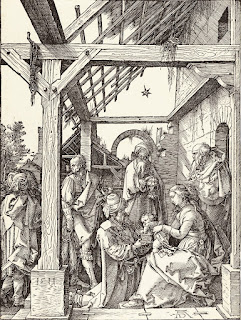
Albrecht Dürer: The Adoration of the Magi

1511 woodcut, National Gallery of Art


Isaiah 60:1–6


Imagine a Time


Isaiah here imagines when

The shoe is on the other foot,

And Israel, in exile then,

One day would find acclaim—and loot!


But, though, like gold and frankincense,

The wealth would come, the nation’s light

Would be the draw for those from whence

Dark sadness was the whole world’s flight.


And so, the prophet did not yearn

So much the nation would be great,

But for the time when all would burn

With love the world would emulate.


America, of old, once thought

That we’re a city on a hill,

So, at our best, our nation sought

To be a people of good will.


Can we, whose life might others lift,

Return to how the world might see

This grand experiment a gift

For those who yearn for liberty?


And might the church, a prophet be,

Awakening each neighborhood

To our responsibility

For showing we believe God’s good?


Scott L. Barton


Arise, shine; for your light has come,

   and the glory of the LORD has risen upon you.

For darkness shall cover the earth,

   and thick darkness the peoples;

 but the LORD will arise upon you,

    and his glory will appear over you.

Nations shall come to your light,

    and kings to the brightness of your dawn.


Lift up your eyes and look around;

    they all gather together, they come to you;

your sons shall come from far away,

    and your daughters shall be carried on their nurses’ arms.

Then you shall see and be radiant;

    your heart shall thrill and rejoice,

because the abundance of the sea shall be brought to you,

    the wealth of the nations shall come to you.

A multitude of camels shall cover you,

    the young camels of Midian and Ephah;

    all those from Sheba shall come.

They shall bring gold and frankincense,

    and shall proclaim the praise of the LORD.


+ + +


Matthew 2:1–12


So We Might Kneel


I picture Herod calm and cool,

Who, though afraid, was no one's fool,

And asked the wise men where was born

Messiah, now that he'd been warned.


I picture in his royal world

A Snidely Whiplash, mustache curled,

Whose soto voce, "Bwa-ha-ha"

Lurked underneath his claimed, "Hurrah!"


Once more, then, this Epiphany,

Beware the one who claims to see

The news of Christ with words so glib

He'd keep the baby in his crib—


And do him in! But picture now

Those seekers who could disavow

Belief Jerus'lem was the key

—E'en though Isaiah said 'twould be—


And went with Micah, who proclaimed

That Bethlehem would be acclaimed

The place from whom a shepherd king

To all the world good news would bring!


Another road those magi took,

(The wise men, who at first, mistook

The way of love that God revealed)

So we, like them, in awe might kneel.


Scott L. Barton


(Cf. the Isaiah text [Jerusalem] with Micah 5:2-5a [Bethlehem])


In the time of King Herod, after Jesus was born in Bethlehem of Judea, wise men from the East came to Jerusalem, asking, “Where is the child who has been born king of the Jews? For we observed his star at its rising, and have come to pay him homage.” When King Herod heard this, he was frightened, and all Jerusalem with him; and calling together all the chief priests and scribes of the people, he inquired of them where the Messiah was to be born. They told him, “In Bethlehem of Judea; for so it has been written by the prophet: ‘And you, Bethlehem, in the land of Judah, are by no means least among the rulers of Judah; for from you shall come a ruler who is to shepherd my people Israel.’” Then Herod secretly called for the wise men and learned from them the exact time when the star had appeared. Then he sent them to Bethlehem, saying, “Go and search diligently for the child; and when you have found him, bring me word so that I may also go and pay him homage.”


When they had heard the king, they set out; and there, ahead of them, went the star that they had seen at its rising, until it stopped over the place where the child was. When they saw that the star had stopped, they were overwhelmed with joy. On entering the house, they saw the child with Mary his mother; and they knelt down and paid him homage. Then, opening their treasure chests, they offered him gifts of gold, frankincense, and myrrh. And having been warned in a dream not to return to Herod, they left for their own country by another road.

Bonus Poem: ‘Twas A Few Days After Christmas

The children and their children have all left, 

The last driveway goodbyes, hugs and I love yous 

Preceding the honks of their cars, 

Heading down to Route 9 and the Turnpike, 

Heading east, from whence will soon come the Magi. 

My wife and I, wise with our years, walk inside, 

I fix the last eggnog, embellished, and she her tea; 

I put on the new CD of Ma and Ax and Beethoven, 

And we sink into our chairs by the still-fresh tree, 

She on her I-Pad, while I open Barrie’s “A Way with Words,” 

At least until we both nod off in a nap, where, no doubt,

Visions of those sweet ones will dance in our heads.


Merry Christmas!


Scott L. Barton

Monday, December 27, 2021

Second Sunday of Christmas (C), January 2, 2022—Jeremiah 31:7–14; John 1:(1–9) 10–18

Mike Chapman: Christ Child Just Born (1999) 

St. Martin-in-the-Fields, London


Jeremiah 31:7–14


In-Gathering


This year, it won’t take much imagination

To know that Jeremiah’s declaration

That exiles would come home from desolation

Was told with optimistic expectation!


For this year’s seen an end to deprivation

Where COVID caused such empty separations;

And though for many there was devastation,

So many have returned for celebrations.


Perhaps you know the joy of restoration,

And have been gathered in from isolation;

You know the end can come for lamentation—

Your dancing signifies a new creation!

Scott L. Barton

For thus says the Lord: Sing aloud with gladness for Jacob, and raise shouts for the chief of the nations; proclaim, give praise, and say, “Save, O Lord, your people, the remnant of Israel.” See, I am going to bring them from the land of the north, and gather them from the farthest parts of the earth, among them the blind and the lame, those with child and those in labor, together; a great company, they shall return here. With weeping they shall come, and with consolations I will lead them back, I will let them walk by brooks of water, in a straight path in which they shall not stumble; for I have become a father to Israel, and Ephraim is my firstborn.

Hear the word of the Lord, O nations, and declare it in the coastlands far away; say, “He who scattered Israel will gather him, and will keep him as a shepherd a flock.” For the Lord has ransomed Jacob, and has redeemed him from hands too strong for him. They shall come and sing aloud on the height of Zion, and they shall be radiant over the goodness of the Lord, over the grain, the wine, and the oil, and over the young of the flock and the herd; their life shall become like a watered garden, and they shall never languish again. Then shall the young women rejoice in the dance, and the young men and the old shall be merry. I will turn their mourning into joy, I will comfort them, and give them gladness for sorrow. I will give the priests their fill of fatness, and my people shall be satisfied with my bounty, says the Lord.

+ + +


John 1:(1–9) 10–18


Grace Upon Grace


This prologue,

this introduction,

this forward to John’s Good News,

turns out to be, simply,

a whole long list of gifts

that one might unwrap,

one per day,

in these days of Christmas.

Pick a verse, any verse.

“. . . Word was God.”

“He was in the beginning . . .”

“All things came . . .”

“. . . the light of all people”

“. . . darkness did not overcome”

“. . . a man sent from God”

“. . . all might believe through him.”

And so on.

John’s just getting started,

warmed up for telling his story,

uncovering the jewels that

you, too, can stick in your back pocket

to pull out some day

when you need a reminder that,

even if you don’t see God today,

grace and truth are still yours

because of this Jesus, this Christ,

this astonishing news for a New Year.


In the beginning was the Word, and the Word was with God, and the Word was God. He was in the beginning with God. All things came into being through him, and without him not one thing came into being. What has come into being in him was life, and the life was the light of all people. The light shines in the darkness, and the darkness did not overcome it.


There was a man sent from God, whose name was John. He came as a witness to testify to the light, so that all might believe through him. He himself was not the light, but he came to testify to the light. The true light, which enlightens everyone, was coming into the world.


He was in the world, and the world came into being through him; yet the world did not know him. He came to what was his own, and his own people did not accept him. But to all who received him, who believed in his name, he gave power to become children of God, who were born, not of blood or of the will of the flesh or of the will of man, but of God.


And the Word became flesh and lived among us, and we have seen his glory, the glory as of a father’s only son, full of grace and truth. (John testified to him and cried out, “This was he of whom I said, ‘He who comes after me ranks ahead of me because he was before me.’”) From his fullness we have all received, grace upon grace. The law indeed was given through Moses; grace and truth came through Jesus Christ. No one has ever seen God. It is God the only Son, who is close to the Father’s heart, who has made him known.