Sunday, January 9, 2022

Second Sunday after the Epiphany (C), January 16, 2022—Isaiah 62:1–5; John 2:1–11


Vie de Jesus MAFA


Isaiah 62:1–5


Proposal


If you were thinking you would wed,

Would you choose one who’s almost dead?

But if you were the latter, dying,

Would you, betrothed, for joy be crying?

Isaiah thus describes a God

Who, unlike others, is so odd,

The Maker of creation chooses

To love those whom the world refuses;

And if such love you can’t conceive,

Just stop. For you need just receive.


Scott L. Barton


For Zion's sake I will not keep silent,

and for Jerusalem's sake I will not rest,

until her vindication shines out like the dawn,

and her salvation like a burning torch.

The nations shall see your vindication,

and all the kings your glory;

and you shall be called by a new name

that the mouth of the LORD will give.

You shall be a crown of beauty in the hand of the LORD,

and a royal diadem in the hand of your God.

You shall no more be termed Forsaken,

and your land shall no more be termed Desolate;

but you shall be called My Delight Is in Her,

and your land Married;

for the LORD delights in you,

and your land shall be married.

For as a young man marries a young woman,

so shall your builder marry you,

and as the bridegroom rejoices over the bride,

so shall your God rejoice over you.


+ + +


John 2:1–11


What Makes You Think You Don't Need It?


This Jewish mother knew the score;

She knew her son could do much more

Than just sit back, all uninvolved;

And so, this ponderer resolved

That she'd weigh in, and speak her mind,

E'en though, this son of hers, unkindly

Snapped!

                    Sometimes you need a push

To get yourself up off your tush;

And if that's true of even God,

Perhaps for you, it's not so odd.


Scott L. Barton


On the third day there was a wedding in Cana of Galilee, and the mother of Jesus was there. Jesus and his disciples had also been invited to the wedding. When the wine gave out, the mother of Jesus said to him, “They have no wine.” And Jesus said to her, “Woman, what concern is that to you and to me? My hour has not yet come.” His mother said to the servants, “Do whatever he tells you.” Now standing there were six stone water jars for the Jewish rites of purification, each holding twenty or thirty gallons. Jesus said to them, “Fill the jars with water.” And they filled them up to the brim. He said to them, “Now draw some out, and take it to the chief steward.” So they took it. When the steward tasted the water that had become wine, and did not know where it came from (though the servants who had drawn the water knew), the steward called the bridegroom and said to him, “Everyone serves the good wine first, and then the inferior wine after the guests have become drunk. But you have kept the good wine until now.” Jesus did this, the first of his signs, in Cana of Galilee, and revealed his glory; and his disciples believed in him.


Baptism of the Lord (C), January 9, 2022—Acts 8:14–17; Isaiah 43:1–7 and Luke 3:15–17, 21–22

12th century mosaic

in Cappella Palatina,

Palermo, Italy


Acts 8:14–17


Holy! Holy! Holy!


What makes

the Holy Spirit

but the fact,

the revelation,

that we’re not alone!

Peter and John

laid their hands

on the Samaritans,

and they knew.

That’s all it took.

And so it always is—

the handshake,

the warm hug,

the embrace,

the touch on the arm,

the laying on of hands,

the feel of water

from the community’s pool

(no matter its size);

and all of these announce

to one and to all,

that he is not alone,

that she is not alone.

You. Are. Not. Alone.

That’s how God works.

Holy! Holy! Holy!


Scott L. Barton


Now when the apostles at Jerusalem heard that Samaria had accepted the word of God, they sent Peter and John to them. The two went down and prayed for them that they might receive the Holy Spirit (for as yet the Spirit had not come upon any of them; they had only been baptized in the name of the Lord Jesus). Then Peter and John laid their hands on them, and they received the Holy Spirit.


+ + +


Isaiah 43:1–7 and Luke 3:15–17, 21–22


Unplumbed Depths


We think we know this Jesus and

We've got him all pinned down,

Until he gets himself baptized,

Like everyone in town.

But then a voice is heard that he's 

Beloved! God's well-pleased!

Remember how Isaiah said,

With passion, God was seized

With love for people cast afar,

And pleaded they would know

The steps God takes so they might see

God's love still overflow?

These waters Jesus passes through

Say you can never plumb

The depths, nor height, nor length of love

That nothing overcomes.


Scott L. Barton


But now thus says the Lord, 

he who created you, O Jacob, 

he who formed you, O Israel: 

Do not fear, for I have redeemed you; 

I have called you by name, you are mine. 

When you pass through the waters, I will be with you; 

and through the rivers, they shall not overwhelm you; 

when you walk through fire you shall not be burned, 

and the flame shall not consume you. 

For I am the Lord your God, 

the Holy One of Israel, your Savior. 

I give Egypt as your ransom, 

Ethiopia and Seba in exchange for you. 

Because you are precious in my sight, 

and honored, and I love you, 

I give people in return for you, 

nations in exchange for your life. 

Do not fear, for I am with you; 

I will bring your offspring from the east, 

and from the west I will gather you; 

I will say to the north, “Give them up,” 

and to the south, “Do not withhold; 

bring my sons from far away 

and my daughters from the end of the earth— 

everyone who is called by my name, 

whom I created for my glory, 

whom I formed and made.”


+  +  +


As the people were filled with expectation, and all were questioning in their hearts concerning John, whether he might be the Messiah, John answered all of them by saying, “I baptize you with water; but one who is more powerful than I is coming; I am not worthy to untie the thong of his sandals. He will baptize you with the Holy Spirit and fire. His winnowing fork is in his hand, to clear his threshing floor and to gather the wheat into his granary; but the chaff he will burn with unquenchable fire.”


Now when all the people were baptized, and when Jesus also had been baptized and was praying, the heaven was opened, and the Holy Spirit descended upon him in bodily form like a dove. And a voice came from heaven, “You are my Son, the Beloved; with you I am well pleased.”


Sunday, January 2, 2022

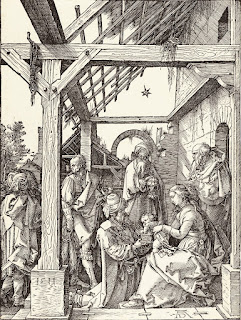
Epiphany of the Lord (C), January 6, 2022—Isaiah 60:1–6 and Matthew 2:1–12


Albrecht Dürer: The Adoration of the Magi

1511 woodcut, National Gallery of Art


Isaiah 60:1–6


Imagine a Time


Isaiah here imagines when

The shoe is on the other foot,

And Israel, in exile then,

One day would find acclaim—and loot!


But, though, like gold and frankincense,

The wealth would come, the nation’s light

Would be the draw for those from whence

Dark sadness was the whole world’s flight.


And so, the prophet did not yearn

So much the nation would be great,

But for the time when all would burn

With love the world would emulate.


America, of old, once thought

That we’re a city on a hill,

So, at our best, our nation sought

To be a people of good will.


Can we, whose life might others lift,

Return to how the world might see

This grand experiment a gift

For those who yearn for liberty?


And might the church, a prophet be,

Awakening each neighborhood

To our responsibility

For showing we believe God’s good?


Scott L. Barton


Arise, shine; for your light has come,

   and the glory of the LORD has risen upon you.

For darkness shall cover the earth,

   and thick darkness the peoples;

 but the LORD will arise upon you,

    and his glory will appear over you.

Nations shall come to your light,

    and kings to the brightness of your dawn.


Lift up your eyes and look around;

    they all gather together, they come to you;

your sons shall come from far away,

    and your daughters shall be carried on their nurses’ arms.

Then you shall see and be radiant;

    your heart shall thrill and rejoice,

because the abundance of the sea shall be brought to you,

    the wealth of the nations shall come to you.

A multitude of camels shall cover you,

    the young camels of Midian and Ephah;

    all those from Sheba shall come.

They shall bring gold and frankincense,

    and shall proclaim the praise of the LORD.


+ + +


Matthew 2:1–12


So We Might Kneel


I picture Herod calm and cool,

Who, though afraid, was no one's fool,

And asked the wise men where was born

Messiah, now that he'd been warned.


I picture in his royal world

A Snidely Whiplash, mustache curled,

Whose soto voce, "Bwa-ha-ha"

Lurked underneath his claimed, "Hurrah!"


Once more, then, this Epiphany,

Beware the one who claims to see

The news of Christ with words so glib

He'd keep the baby in his crib—


And do him in! But picture now

Those seekers who could disavow

Belief Jerus'lem was the key

—E'en though Isaiah said 'twould be—


And went with Micah, who proclaimed

That Bethlehem would be acclaimed

The place from whom a shepherd king

To all the world good news would bring!


Another road those magi took,

(The wise men, who at first, mistook

The way of love that God revealed)

So we, like them, in awe might kneel.


Scott L. Barton


(Cf. the Isaiah text [Jerusalem] with Micah 5:2-5a [Bethlehem])


In the time of King Herod, after Jesus was born in Bethlehem of Judea, wise men from the East came to Jerusalem, asking, “Where is the child who has been born king of the Jews? For we observed his star at its rising, and have come to pay him homage.” When King Herod heard this, he was frightened, and all Jerusalem with him; and calling together all the chief priests and scribes of the people, he inquired of them where the Messiah was to be born. They told him, “In Bethlehem of Judea; for so it has been written by the prophet: ‘And you, Bethlehem, in the land of Judah, are by no means least among the rulers of Judah; for from you shall come a ruler who is to shepherd my people Israel.’” Then Herod secretly called for the wise men and learned from them the exact time when the star had appeared. Then he sent them to Bethlehem, saying, “Go and search diligently for the child; and when you have found him, bring me word so that I may also go and pay him homage.”


When they had heard the king, they set out; and there, ahead of them, went the star that they had seen at its rising, until it stopped over the place where the child was. When they saw that the star had stopped, they were overwhelmed with joy. On entering the house, they saw the child with Mary his mother; and they knelt down and paid him homage. Then, opening their treasure chests, they offered him gifts of gold, frankincense, and myrrh. And having been warned in a dream not to return to Herod, they left for their own country by another road.

Bonus Poem: ‘Twas A Few Days After Christmas

The children and their children have all left, 

The last driveway goodbyes, hugs and I love yous 

Preceding the honks of their cars, 

Heading down to Route 9 and the Turnpike, 

Heading east, from whence will soon come the Magi. 

My wife and I, wise with our years, walk inside, 

I fix the last eggnog, embellished, and she her tea; 

I put on the new CD of Ma and Ax and Beethoven, 

And we sink into our chairs by the still-fresh tree, 

She on her I-Pad, while I open Barrie’s “A Way with Words,” 

At least until we both nod off in a nap, where, no doubt,

Visions of those sweet ones will dance in our heads.


Merry Christmas!


Scott L. Barton

Monday, December 27, 2021

Second Sunday of Christmas (C), January 2, 2022—Jeremiah 31:7–14; John 1:(1–9) 10–18

Mike Chapman: Christ Child Just Born (1999) 

St. Martin-in-the-Fields, London


Jeremiah 31:7–14


In-Gathering


This year, it won’t take much imagination

To know that Jeremiah’s declaration

That exiles would come home from desolation

Was told with optimistic expectation!


For this year’s seen an end to deprivation

Where COVID caused such empty separations;

And though for many there was devastation,

So many have returned for celebrations.


Perhaps you know the joy of restoration,

And have been gathered in from isolation;

You know the end can come for lamentation—

Your dancing signifies a new creation!

Scott L. Barton

For thus says the Lord: Sing aloud with gladness for Jacob, and raise shouts for the chief of the nations; proclaim, give praise, and say, “Save, O Lord, your people, the remnant of Israel.” See, I am going to bring them from the land of the north, and gather them from the farthest parts of the earth, among them the blind and the lame, those with child and those in labor, together; a great company, they shall return here. With weeping they shall come, and with consolations I will lead them back, I will let them walk by brooks of water, in a straight path in which they shall not stumble; for I have become a father to Israel, and Ephraim is my firstborn.

Hear the word of the Lord, O nations, and declare it in the coastlands far away; say, “He who scattered Israel will gather him, and will keep him as a shepherd a flock.” For the Lord has ransomed Jacob, and has redeemed him from hands too strong for him. They shall come and sing aloud on the height of Zion, and they shall be radiant over the goodness of the Lord, over the grain, the wine, and the oil, and over the young of the flock and the herd; their life shall become like a watered garden, and they shall never languish again. Then shall the young women rejoice in the dance, and the young men and the old shall be merry. I will turn their mourning into joy, I will comfort them, and give them gladness for sorrow. I will give the priests their fill of fatness, and my people shall be satisfied with my bounty, says the Lord.

+ + +


John 1:(1–9) 10–18


Grace Upon Grace


This prologue,

this introduction,

this forward to John’s Good News,

turns out to be, simply,

a whole long list of gifts

that one might unwrap,

one per day,

in these days of Christmas.

Pick a verse, any verse.

“. . . Word was God.”

“He was in the beginning . . .”

“All things came . . .”

“. . . the light of all people”

“. . . darkness did not overcome”

“. . . a man sent from God”

“. . . all might believe through him.”

And so on.

John’s just getting started,

warmed up for telling his story,

uncovering the jewels that

you, too, can stick in your back pocket

to pull out some day

when you need a reminder that,

even if you don’t see God today,

grace and truth are still yours

because of this Jesus, this Christ,

this astonishing news for a New Year.


In the beginning was the Word, and the Word was with God, and the Word was God. He was in the beginning with God. All things came into being through him, and without him not one thing came into being. What has come into being in him was life, and the life was the light of all people. The light shines in the darkness, and the darkness did not overcome it.


There was a man sent from God, whose name was John. He came as a witness to testify to the light, so that all might believe through him. He himself was not the light, but he came to testify to the light. The true light, which enlightens everyone, was coming into the world.


He was in the world, and the world came into being through him; yet the world did not know him. He came to what was his own, and his own people did not accept him. But to all who received him, who believed in his name, he gave power to become children of God, who were born, not of blood or of the will of the flesh or of the will of man, but of God.


And the Word became flesh and lived among us, and we have seen his glory, the glory as of a father’s only son, full of grace and truth. (John testified to him and cried out, “This was he of whom I said, ‘He who comes after me ranks ahead of me because he was before me.’”) From his fullness we have all received, grace upon grace. The law indeed was given through Moses; grace and truth came through Jesus Christ. No one has ever seen God. It is God the only Son, who is close to the Father’s heart, who has made him known.


First Sunday of Christmas (C), December 26, 2021—1 Samuel 2:18–20, 26; Luke 2:41–52

1 Samuel 2:18–20, 26

N. C. Wyeth: Eli and the Boy Samuel

(1928. Illustration in the March 1929 issue of Good Housekeeping Magazine,

Somerville Manning Gallery, 43”x33” oil, for sale)


Passing It On


They say that imitation’s

The sincerest form of flattery.

Thus, Luke sincerely must have liked

Old Samuel’s author’s mastery,

And copied nearly word for word

How Jesus, a young shaver,

In wisdom and in stature grew

In God’s and human favor.


He must have thought that Samuel,

Such a consummate anointer,

Devoted to old Eli,

To another was a pointer;

Another who would be a king,

But not of any nation,

Who lived so love for humankind

Might be our dedication.

Scott L. Barton

Samuel was ministering before the Lord, a boy wearing a linen ephod. His mother used to make for him a little robe and take it to him each year, when she went up with her husband to offer the yearly sacrifice. Then Eli would bless Elkanah and his wife, and say, “May the Lord repay you with children by this woman for the gift that she made to the Lord”; and then they would return to their home.


Now the boy Samuel continued to grow both in stature and in favor with the Lord and with the people.


+  +  +

Luke 2:41–52

Max Liebermann: The 12-Year-Old Jesus in the Temple (1879)


Questions About This Odd Text


I have many questions about this odd text

Where the soon-to-be teenager’s parents were vexed

By the child who went off and then worried them sick,

And they scratched their heads, saying, “What makes this boy tick?”


Oh, why did they travel e’en just for a day,

While, with neighbors, they thought he was still on the way?

And I wonder just where for three days did he stay?

Did he sleep? Did he eat? Did he ever once play?


And why such obedience back at the house?

Was he loud, in high spirits, or quiet as a mouse?

Most of all, I ask why in God’s favor he grew?

And then how in God’s name was this something Luke knew?


Like Mary, I treasure these things in my heart,

While the text, in another way, Mystery imparts.


Scott L. Barton 


Now every year his parents went to Jerusalem for the festival of the Passover. And when he was twelve years old, they went up as usual for the festival. When the festival was ended and they started to return, the boy Jesus stayed behind in Jerusalem, but his parents did not know it.Assuming that he was in the group of travelers, they went a day’s journey. Then they started to look for him among their relatives and friends. When they did not find him, they returned to Jerusalem to search for him. After three days they found him in the temple, sitting among the teachers, listening to them and asking them questions. And all who heard him were amazed at his understanding and his answers. When his parents saw him they were astonished; and his mother said to him, “Child, why have you treated us like this? Look, your father and I have been searching for you in great anxiety.” He said to them, “Why were you searching for me? Did you not know that I must be in my Father’s house?” But they did not understand what he said to them. Then he went down with them and came to Nazareth, and was obedient to them. His mother treasured all these things in her heart. And Jesus increased in wisdom and in years, and in divine and human favor.


Saturday, December 18, 2021

Christmas Eve/Nativity of our Lord (A, B, C)—Isaiah 9:2-7; Luke 2:1–20

Isaiah 9:2–7


The Zeal We Sing


Isaiah could have never known

How words like “wonderful,” and “counselor,”

Would wind up sung by countless choirs

Where Handel’s beauty’s n’er outgrown.


And yet, the force of octaves sung

Cannot compare to burning warriors’ boots

And garments rolled in battle’s blood,

To signal war and hate undone.


How strange this promise, and how bold!

Imagine, overpowered by some foe,

And sent away in exile, far,

Yet still, your God you can behold!


The child Isaiah had in mind

We know as Jesus, born this very night;

We sing to claim his peace is near,

Who bids his life, our lives define.


Scott L. Barton


The people who walked in darkness

          have seen a great light;

     those who lived in a land of deep darkness —

          on them light has shined.

You have multiplied the nation,

          you have increased its joy;

     they rejoice before you

          as with joy at the harvest,

          as people exult when dividing plunder.

For the yoke of their burden,

          and the bar across their shoulders,

          the rod of their oppressor,

          you have broken as on the day of Midian.

For all the boots of the tramping warriors

          and all the garments rolled in blood

          shall be burned as fuel for the fire.

For a child has been born for us,

          a son given to us;

     authority rests upon his shoulders;

          and he is named

     Wonderful Counselor, Mighty God,

          Everlasting Father, Prince of Peace.

His authority shall grow continually,

          and there shall be endless peace

     for the throne of David and his kingdom.

          He will establish and uphold it

     with justice and with righteousness

          from this time onward and forevermore.

     The zeal of the LORD of hosts will do this.


+  +  +


Luke 2:1–20


Imogene Herdman, "Hey! Unto you a child is born!" 

in Barbara Robinson's The Best Christmas Pageant Ever


Solstice


"It's the big night!"

Is what my father used to say,

And then in June,

It was, "Tomorrow's the big day!"

—Thus, the solstice

Always arrives for me with mirth,

Which may be what

We need to hear about this birth

Announced each year!

The angel spoke with twinkling eyes,

—Thus, cast out fear—

So they would laugh with great surprise;

Despite the dark,

This same news called to us this night

Begs to be told,,

That Love might be our solstice light.


Scott L. Barton


Peter Busch: No Room at the Inn. Sand sculpture,
Belen de arena de Las Canteras, Plaza Saulo Toron,
Canary Islands, Spain.


When History Repeats Itself


It was a terrifying time

Which we, by faith, now think sublime;

But then, a madman on the throne,

Drove everyone away from home,

That everyone be taxed and counted;

But this, in point of fact, amounted

To terrorism by the high,

Who gave no choice but to comply.


Think, immigrants; think, refugees;

Think how all those of low degree

In every age are made to do

The bidding of a mighty few.

Think those who fear they'll be deported,

Their work, and fam'ly life now thwarted;

Think those from bombed out cities fleeing,

What kind of news would bring wellbeing?


Imagine they see in the flesh,

Perhaps in angels and a crèche,

Or maybe, solidarity

From those who bear Christ's guarantee

That he'll be with us all our days!

Then they, as well, might be amazed—

Like shepherds hearing angel choirs—

What real love from God requires.


Thus into angst and grief and fears

The God of every soul appears,

Yes, then, but also here, today,

And bids us live just as we pray.


Scott L. Barton


The Rev. Richard Manzelmann, who died this year at the age of 92, used this on the "Christmas Sunday" bulletin cover in 1974 at New Hartford, New York Presbyterian Church. I used it on occasion for the same purpose over the years but would love to know its source. It seems like a Rembrandt, but I can't confirm that.


To Make Our Love Braver


She did something different,

She treasured and pondered;

Not only amazed, but

She thought, and she wondered

Just what was their meaning—

That this diapered wee boy,

Would be to all people

The sign of a great joy?


And why even now does

He cause such a flutter

In hearts all around, while

These carols we utter?

Is this what they meant when

They said that a savior

Would come—a Messiah,

To make our love braver?


Scott L. Barton


Rembrandt van Rijn:

The Angel Appearing to the Shepherds


They Thought It Was the Feds


Perhaps they thought it was the Feds who'd come for them!

Somehow, the N.S.A. had tracked, and would condemn

Those dirty shepherds, since they had not registered,

And since, without green cards, Augustus' wrath incurred!

But soon they found the searchlight not to be the law,

Which, with relief, provoked a different kind of awe;

That is, more powerful than all the "powers that be,"

Was then announced - as now - the holy mystery:

Quite openly, the one who saves comes not by strength

Of arm, but will not fail to go to any length

For love!  Thus wrapped, so even shepherds might embrace

This child, we, too, now hold our breath, to see such grace.


Scott L. Barton

(Originally published in The Presbyterian Outlook 12/09/13)


In those days a decree went out from Emperor Augustus that all the world should be registered. This was the first registration and was taken while Quirinius was governor of Syria. All went to their own towns to be registered. Joseph also went from the town of Nazareth in Galilee to Judea, to the city of David called Bethlehem, because he was descended from the house and family of David. He went to be registered with Mary, to whom he was engaged and who was expecting a child. While they were there, the time came for her to deliver her child. And she gave birth to her firstborn son and wrapped him in bands of cloth, and laid him in a manger, because there was no place for them in the inn.


In that region there were shepherds living in the fields, keeping watch over their flock by night. Then an angel of the Lord stood before them, and the glory of the Lord shone around them, and they were terrified. But the angel said to them, “Do not be afraid; for see—I am bringing you good news of great joy for all the people: to you is born this day in the city of David a Savior, who is the Messiah, the Lord. This will be a sign for you: you will find a child wrapped in bands of cloth and lying in a manger.” And suddenly there was with the angel a multitude of the heavenly host, praising God and saying, “Glory to God in the highest heaven, and on earth peace among those whom he favors!” When the angels had left them and gone into heaven, the shepherds said to one another, “Let us go now to Bethlehem and see this thing that has taken place, which the Lord has made known to us.” So they went with haste and found Mary and Joseph, and the child lying in the manger. When they saw this, they made known what had been told them about this child;and all who heard it were amazed at what the shepherds told them. But Mary treasured all these words and pondered them in her heart. The shepherds returned, glorifying and praising God for all they had heard and seen, as it had been told them.