Friday, February 18, 2022

Transfiguration Sunday (C), February 27, 2022—Exodus 34:29–35; 2 Corinthians 3:12—4:2; Luke 9:28–36 (37–43)


Duccio di Buoninsegna: Transfiguration of Christ 
Panel from the Maesta altarpiece, Siena, Italy (1308-1311)

Exodus 34:29–35; 2 Corinthians 3:12—4:2; and Luke 9:28–36 (37–43)

What Is It with the Bible and Veils?

Moses’ face he has to hide,

It’s way too scary being near the

One with whom our God abides;

Then Peter, James and John see Jesus

Dazzling white up on that mount

With Moses and Elijah, talking,

Peter makes a quick head count

(Perhaps the better to preserve it)

Next creeps in—that veil! A cloud

O’ershadows them! And they see nothing,

Hearing, though, that voice, aloud,

The same voice long ago to Moses,

They know Jesus is the one

To follow down the hill, to where that

Boy is healed—and they become

Astounded at the mighty acts of

God, who in this Jesus takes

The veils away! And so St. Paul says,

(Here’s the thing:) Make no mistake!

The glory of this Lord is seen when

—By God!—we will not lose heart,

But see, somehow, God in each other,

Rather than our God, apart!


Think not in terms of God in veils,

But God in neighbor, grace entails.


Scott L. Barton 


+ + +


Luke 9:28–36 (37–43)


By Love Configured


He goes up to the mount to pray

Not knowing what will come his way,

Since just a week ago he said

That he’d be killed, yet from the dead

He’d rise—that is, if he’s the one!


Soon, Peter, most of all undone

By such a prayer that went both ways

—That is, was answered!—is amazed

To see the Law and Prophets now

Boiled down to one so light-endowed.


Rebuking, next, that spirit, strong,

The chosen one won’t go along

With evil that a boy would ground,

Which did each one who saw, astound.


And Luke, his tale as here configured

Invites us still to be transfigured.


Scott L.Barton

 + + +


This would work very well as the closing hymn:


Crucified Lord Who Rose So We Might Live

NICAEA 

Scott L. Barton (2014)              John Bacchus Dykes (1861) 


Holy, holy, holy! Lord God Almighty!

After six days, you took them up the mountainside,

There a new defining, in your face all shining,

You, our new Moses, ever here abide.


We have come before you, seeking to adore you,

In this sanctuary, our songs to you we raise,

Your word still astounds us, grace for all surrounds us,

Our love for you, and all, our greatest praise.


There is no delaying, for we hear you saying,

“Follow where I go, and cure the sick and heal the lame;

Folk of every label, welcome to my table,

Fear not, by faith, my love to all proclaim.”


Holy, holy, holy! Lord God Almighty!

Now we go returning, out to the world you give;

Traveling together, through all kinds of weather,

Crucified Lord, who rose so we might live!


Scott L.Barton 


Moses came down from Mount Sinai. As he came down from the mountain with the two tablets of the covenant in his hand, Moses did not know that the skin of his face shone because he had been talking with God. When Aaron and all the Israelites saw Moses, the skin of his face was shining, and they were afraid to come near him. But Moses called to them; and Aaron and all the leaders of the congregation returned to him, and Moses spoke with them. Afterward all the Israelites came near, and he gave them in commandment all that the Lord had spoken with him on Mount Sinai. When Moses had finished speaking with them, he put a veil on his face; but whenever Moses went in before the Lord to speak with him, he would take the veil off, until he came out; and when he came out, and told the Israelites what he had been commanded, the Israelites would see the face of Moses, that the skin of his face was shining; and Moses would put the veil on his face again, until he went in to speak with him.  

+  +  +

Since, then, we have such a hope, we act with great boldness, not like Moses, who put a veil over his face to keep the people of Israel from gazing at the end of the glory that was being set aside. But their minds were hardened. Indeed, to this very day, when they hear the reading of the old covenant, that same veil is still there, since only in Christ is it set aside. Indeed, to this very day whenever Moses is read, a veil lies over their minds; but when one turns to the Lord, the veil is removed. Now the Lord is the Spirit, and where the Spirit of the Lord is, there is freedom. And all of us, with unveiled faces, seeing the glory of the Lord as though reflected in a mirror, are being transformed into the same image from one degree of glory to another; for this comes from the Lord, the Spirit.

Therefore, since it is by God’s mercy that we are engaged in this ministry, we do not lose heart. We have renounced the shameful things that one hides; we refuse to practice cunning or to falsify God’s word; but by the open statement of the truth we commend ourselves to the conscience of everyone in the sight of God.

+ + +
 
Now about eight days after these sayings Jesus took with him Peter and John and James, and went up on the mountain to pray. And while he was praying, the appearance of his face changed, and his clothes became dazzling white. Suddenly they saw two men, Moses and Elijah, talking to him. They appeared in glory and were speaking of his departure, which he was about to accomplish at Jerusalem. Now Peter and his companions were weighed down with sleep; but since they had stayed awake, they saw his glory and the two men who stood with him. Just as they were leaving him, Peter said to Jesus, “Master, it is good for us to be here; let us make three dwellings, one for you, one for Moses, and one for Elijah” —not knowing what he said. While he was saying this, a cloud came and overshadowed them; and they were terrified as they entered the cloud.Then from the cloud came a voice that said, “This is my Son, my Chosen; listen to him!” When the voice had spoken, Jesus was found alone. And they kept silent and in those days told no one any of the things they had seen.

On the next day, when they had come down from the mountain, a great crowd met him. Just then a man from the crowd shouted, “Teacher, I beg you to look at my son; he is my only child. Suddenly a spirit seizes him, and all at once he shrieks. It convulses him until he foams at the mouth; it mauls him and will scarcely leave him. I begged your disciples to cast it out, but they could not.” Jesus answered, “You faithless and perverse generation, how much longer must I be with you and bear with you? Bring your son here.” While he was coming, the demon dashed him to the ground in convulsions. But Jesus rebuked the unclean spirit, healed the boy, and gave him back to his father.

And all were astounded at the greatness of God.
 
+ + +
 

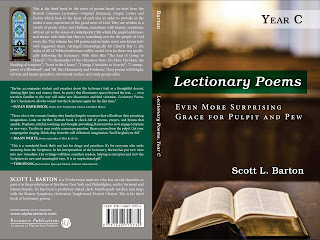
Lectionary Poems, Year C: Even More Surprising Grace for Pulpit and Pew, which has all these poems for the year, 150 of them, including seven new hymn texts, with two indices of scriptural references and titles, is available from Wipf and Stock, Amazon, or, the least expensive, from me, signed and inscribed, for only $11 (which includes tax) and $3.19 postage. Check or Venmo. Write me at scott.l.barton[at sign]gmail[dot com]!  —S.L.B.  


Friday, February 11, 2022

Seventh Sunday after the Epiphany (C), February 20, 2022—Genesis 45:3–11, 15


Marc Chagall: Joseph Recognized by his Brothers (1958)


This Love We’re Still Announcing


I want to know the brothers’ words,

Their groveling apologies;

I want to read just how they felt,

Their deepest guilt psychologies;

I wonder what effect their deeds

Had on lifetime pathologies

Of Joseph and those brothers, grim

At such revealed chronology!

The text, however, doesn’t care

About such modern ponderings;

But rather offers us the choice

To be in awe, and wondering

About the grace this ancient God

Sent to a nation forming,

That it be known by even us,

And lead to our transforming.


Scott L. Barton


Joseph said to his brothers, “I am Joseph. Is my father still alive?” But his brothers could not answer him, so dismayed were they at his presence. Then Joseph said to his brothers, “Come closer to me.” And they came closer. He said, “I am your brother, Joseph, whom you sold into Egypt. And now do not be distressed, or angry with yourselves, because you sold me here; for God sent me before you to preserve life. For the famine has been in the land these two years; and there are five more years in which there will be neither plowing nor harvest. God sent me before you to preserve for you a remnant on earth, and to keep alive for you many survivors. So it was not you who sent me here, but God; he has made me a father to Pharaoh, and lord of all his house and ruler over all the land of Egypt. Hurry and go up to my father and say to him, ‘Thus says your son Joseph, God has made me lord of all Egypt; come down to me, do not delay. You shall settle in the land of Goshen, and you shall be near me, you and your children and your children’s children, as well as your flocks, your herds, and all that you have. I will provide for you there—since there are five more years of famine to come—so that you and your household, and all that you have, will not come to poverty.’ And he kissed all his brothers and wept upon them; and after that his brothers talked with him.


Lectionary Poems, Year C: Even More Surprising Grace for Pulpit and Pew, which has all these poems for the year, 150 of them, including seven new hymn texts, with two indices of scriptural references and titles, is available from Wipf and Stock, Amazon, or, the least expensive, from me, signed and inscribed, for only $11 (which includes tax) and $3.19 postage. Check or Venmo. Write me at scott.l.barton[at sign]gmail[dot com]!  —S.L.B. 


Sunday, February 6, 2022

Sixth Sunday after the Epiphany (C), February 13, 2022— Luke 6:17–26

All Saints church, Haggerston, east London, annual memorial service, 2/3/19, for Joseph Grimaldi, 19th-century English entertainer who popularized modern clowns’ makeup and style.


Send in the Clowns

For Luke, “disciples” means not just “the Twelve,”
Those Jesus gathered, who then dug and delved
To figure out the truth of who he was,
And sang, “What’s happening?” and “What’s the buzz?”

“Disciples” meant the panoply of those
Who simply came to see this man, who chose
To think there still might be, for them, a way
To healing mind and body yet. Today.

Were they some fools to think that they were blessed,
Though poor, though hungry, weeping in distress?
Who were these clowns to hear that if reviled
And hated, they could still rejoice and smile?

Just those who know, through him, how they are loved,
And who, by what he said and did are nudged
To be the clowns together who now show
God works for good. And sing, “Love overflows!”

Scott L. Barton

[Jesus] came down with them and stood on a level place, with a great crowd of his disciples and a great multitude of people from all Judea, Jerusalem, and the coast of Tyre and Sidon. They had come to hear him and to be healed of their diseases; and those who were troubled with unclean spirits were cured. And all in the crowd were trying to touch him, for power came out from him and healed all of them. 


Then he looked up at his disciples and said: “Blessed are you who are poor, for yours is the kingdom of God. “Blessed are you who are hungry now, for you will be filled. “Blessed are you who weep now, for you will laugh. “Blessed are you when people hate you, and when they exclude you, revile you, and defame you on account of the Son of Man. Rejoice in that day and leap for joy, for surely your reward is great in heaven; for that is what their ancestors did to the prophets. “But woe to you who are rich, for you have received your consolation. “Woe to you who are full now, for you will be hungry. “Woe to you who are laughing now, for you will mourn and weep. “Woe to you when all speak well of you, for that is what their ancestors did to the false prophets.


Sunday, January 30, 2022

Bonus Poem: It Seems to Me I've Heard This Song Before

This Bonus Poem was written in response to a friend, a Vietnam vet who is also an active member of Veterans for Peace, who was lamenting, and asking prayers because of, the buildup of weaponry and rhetoric on both sides in Ukraine.


It Seems to Me I've Heard This Song Before


When noisy sabers rattle,

And no one wants to battle,

Except the people who would profit by,

Then folk of every nation,

Make prayer your firm foundation,

And gird your loins to bury battle cries!


S.L.B.

Fifth Sunday after the Epiphany (C), February 6, 2022—Isaiah 6:1–8, (9–13); Luke 5:1–11

 
Lectionary Poems, Year C: Even More Surprising Grace for Pulpit and Pew, which has all these poems for the year, 150 of them, including seven new hymn texts, with two indices of scriptural references and titles, is available from Wipf and Stock, Amazon, or, the least expensive, from me, signed and inscribed, for only $11 (which includes tax) and $3.19 postage. Check or Venmo. Write me at scott.l.barton[at sign]gmail[dot com]!  —S.L.B. 
 
+ + +
 

Isaiah 6:1–8, (9–13) (also the O.T. reading for Trinity Sunday, Year B) 

Marc Chagall, The Prophet Isaiah, 1968

Musée National Marc Chagall, Nice, France.


The Odd and Overwhelming Otherness of God


The odd and overwhelming

     otherness of God

—In which Isaiah stands as if

     he's some divining rod

Who's found the source of life

    and all creatIon's power—

Is followed by so deep a self-

     awareness, he just cowers

In his inadequacy:

     Woe! Lost! And unclean!

And he is doomed, for all

     the majesty that he has seen;

But God has means, it seems,

     the doomed one to reclaim,

The coal in tongs atones,

     and guilt departed is proclaimed.

But lest we think the prophet

     basks in holy bliss,

All-glowing with what must have seemed,

     with such an act, God's kiss,

The one who's touched, looks up,

     and from his bended knee,

And knowing what he's called to do,

     says, "Here I am; send me!"

Such odd, persistent grace

     comes when and where it will;

To you, to me, and everyone,

     So love its name fulfills.


Scott L. Barton


(The phrase "the odd, overwhelming otherness of God," and other ideas in the poem come from Walter Brueggemann's Isaiah 1-39 in the Westminster Bible Companion series, pp. 57-60.)


In the year that King Uzziah died, I saw the Lord sitting on a throne, high and lofty; and the hem of his robe filled the temple. Seraphs were in attendance above him; each had six wings: with two they covered their faces, and with two they covered their feet, and with two they flew. And one called to another and said: 


“Holy, holy, holy is the Lord of hosts; 

the whole earth is full of his glory.” 


The pivots on the thresholds shook at the voices of those who called, and the house filled with smoke.

And I said: “Woe is me! I am lost, for I am a man of unclean lips, and I live among a people of unclean lips; yet my eyes have seen the King, the Lord of hosts!” 


Then one of the seraphs flew to me, holding a live coal that had been taken from the altar with a pair of tongs. The seraph touched my mouth with it and said: “Now that this has touched your lips, your guilt has departed and your sin is blotted out.” Then I heard the voice of the Lord saying, “Whom shall I send, and who will go for us?” And I said, “Here am I; send me!”


 + + +


Luke 5:1–11


Christ Calling the First Disciples

San Pedro Bautista, Candelaria, Philippines

photo, Ramon Velasquez


Winning Combination


He had the winning combination

That’s known by every congregation

When it’s alive and full of spirit

That shows when someone comes to visit;

They found that he was energizing

By doing two things quite surprising.


He simply knew what went unheeded,

And simply did what people needed;

For news from God is what they hungered—

In words both brave, and full of wonder!

Thus he proclaimed, his words the blessing

They then received upon their pressing.


And next, he showed them such astounding

Largesse around them, so abounding,

The efforts of th’entire gath’ring

Were needed to haul in, so stagg’ring

The bounty each and all provided

When by his steering they were guided.


Perhaps belief is overrated,

And God’s providing, understated;

So if you feel you’re catching nothing,

Announce the news that’s still so stunning:

Through all our hunger, wealth and sighing,

To each and all, Love’s here! Supplying!


Scott L. Barton


Once while Jesus was standing beside the lake of Gennesaret, and the crowd was pressing in on him to hear the word of God, he saw two boats there at the shore of the lake; the fishermen had gone out of them and were washing their nets. He got into one of the boats, the one belonging to Simon, and asked him to put out a little way from the shore. Then he sat down and taught the crowds from the boat. When he had finished speaking, he said to Simon, “Put out into the deep water and let down your nets for a catch.” Simon answered, “Master, we have worked all night long but have caught nothing. Yet if you say so, I will let down the nets.” When they had done this, they caught so many fish that their nets were beginning to break. So they signaled their partners in the other boat to come and help them. And they came and filled both boats, so that they began to sink. But when Simon Peter saw it, he fell down at Jesus’ knees, saying, “Go away from me, Lord, for I am a sinful man!” For he and all who were with him were amazed at the catch of fish that they had taken; and so also were James and John, sons of Zebedee, who were partners with Simon. Then Jesus said to Simon, “Do not be afraid; from now on you will be catching people.” When they had brought their boats to shore, they left everything and followed him.


Sunday, January 23, 2022

Fourth Sunday after the Epiphany (C), January 30, 2022 —Jeremiah 1:4–10 and 1 Corinthians 13:1–13; Luke 4:21–30


Lectionary Poems, Year C: Even More Surprising Grace for Pulpit and Pew, which has all these poems for the year, 150 of them, including seven new hymn texts, with two indices of scriptural references and titles, is available from Wipf and Stock, Amazon, or, the least expensive, from me, signed and inscribed, for only $11 (which includes tax) and $3.19 postage. Check or Venmo. Write me at scott.l.barton[at sign]gmail[dot com]!  —S.L.B.


Jeremiah 1:4–10 and 1 Corinthians 13:1–13

Marc Chagall: Jeremiah (1980)


How to Tell the Difference


You'll never know when you'll be called

To do a job that might appall

You otherwise, some other day, 

Without some prod into the fray.


How do you know, though, if it's real,

A call?—or just some clanging spiel

You'd love to make? Perhaps, just take

A look to see whence comes the ache.


Is it your need that you be heard?

Or is it love calls forth some word

Of truth you still find hard to say,

Though God would have you find the way?


Scott L. Barton


Now the word of the Lord came to me saying,

“Before I formed you in the womb I knew you,

and before you were born I consecrated you;

I appointed you a prophet to the nations.”

Then I said, “Ah, Lord God! Truly I do not know how to speak, for I am only a boy.” But the Lord said to me, 

“Do not say, ‘I am only a boy’; 

for you shall go to all to whom I send you, 

and you shall speak whatever I command you, 

Do not be afraid of them, 

for I am with you to deliver you, says the Lord.” 

Then the Lord put out his hand and touched my mouth; and the Lord said to me, 

“Now I have put my words in your mouth. 

See, today I appoint you over nations and over kingdoms, 

to pluck up and to pull down, 

to destroy and to overthrow, 

to build and to plant.”


[also]


If I speak in the tongues of mortals and of angels, but do not have love, I am a noisy gong or a clanging cymbal. And if I have prophetic powers, and understand all mysteries and all knowledge, and if I have all faith, so as to remove mountains, but do not have love, I am nothing. If I give away all my possessions, and if I hand over my body so that I may boast, but do not have love, I gain nothing.


Love is patient; love is kind; love is not envious or boastful or arrogant or rude. It does not insist on its own way; it is not irritable or resentful; it does not rejoice in wrongdoing, but rejoices in the truth. It bears all things, believes all things, hopes all things, endures all things.


Love never ends. But as for prophecies, they will come to an end; as for tongues, they will cease; as for knowledge, it will come to an end. For we know only in part, and we prophesy only in part; but when the complete comes, the partial will come to an end. When I was a child, I spoke like a child, I thought like a child, I reasoned like a child; when I became an adult, I put an end to childish ways. For now we see in a mirror, dimly, but then we will see face to face. Now I know only in part; then I will know fully, even as I have been fully known. And now faith, hope, and love abide, these three; and the greatest of these is love.


+ + +


Luke 4:21–30


James Jacques Joseph Tissot:

Brow of the Hill Near Nazareth (between 1886 and 1894)

Brooklyn Museum, NY


Cliff Note


They tried to throw him off a cliff!

That seems a bit extreme to me,

Although, in other places far away

I read it happens by decree;

Not long ago in Timbuktu,

Extremists had the upper hand—

They took a thief outside the gates,

And at the law's quite clear command,

Some poor guy's now an amputee!

We seem to want to purge the one

Who's different from our midst, as if

Somehow, God's work will then be done!

It's not just there, but even here,

Where fear and anger still drives some

To take the law into their hands,

And think the world is safe from scum.


But Jesus, passing through the crowd,

Reminds us simply: Be not proud.


Scott L. Barton


Then [Jesus] began to say to them, “Today this scripture has been fulfilled in your hearing.” All spoke well of him and were amazed at the gracious words that came from his mouth. They said, “Is not this Joseph’s son?” He said to them, “Doubtless you will quote to me this proverb, ‘Doctor, cure yourself!’ And you will say, ‘Do here also in your hometown the things that we have heard you did at Capernaum.’” And he said, “Truly I tell you, no prophet is accepted in the prophet’s hometown. But the truth is, there were many widows in Israel in the time of Elijah, when the heaven was shut up three years and six months, and there was a severe famine over all the land; yet Elijah was sent to none of them except to a widow at Zarephath in Sidon. There were also many lepers in Israel in the time of the prophet Elisha, and none of them was cleansed except Naaman the Syrian.” When they heard this, all in the synagogue were filled with rage. They got up, drove him out of the town, and led him to the brow of the hill on which their town was built, so that they might hurl him off the cliff. But he passed through the midst of them and went on his way.


Wednesday, January 12, 2022

Third Sunday after the Epiphany, January 23, 2022 (C)—1 Corinthians 12:12–31a; Luke 4:14–21

Lectionary Poems, Year C: Even More Surprising Grace for Pulpit and Pew, which has all these poems for the year, 150 of them, including seven new hymn texts, with two indices of scriptural references and titles, is available from Wipf and Stock, Amazon, or, the least expensive, from me, signed and inscribed, for only $11 (which includes tax) and $3.19 postage. Check or Venmo. Write me at scott.l.barton[at sign]gmail[dot com]!  —S.L.B.


1 Corinthians 12:12–31a


Can “Religion” = Re-ligament Again?


A Jewish friend once wrote to me

About the news from Canterb’ry;*

He thought that Justin Welby seemed

Reactionary, since the seams

Of Anglicans had now been frayed

From sanctions over matters gay.


I told him Welby’s job was tough,

Consid’ring some had had enough,

Preferring the Americans

Would go their separate way, again,

And leave a great and worldwide fold,

A purer church to then behold.


It’s painful that some matters rank

So high to some, they’d draw a blank,

Forgetful of this chapter, where,

Paul says we must with others bear

When they are diff’rent!—since in Christ,

All parts that are in him, suffice.


My friend, no synagogue attends,

And frequently with me contends

Religion is no tie that binds,

But rather splits both hearts and minds;

Sometimes I fear that he is right,

And wish this text be heeded, quite.


Scott L. Barton


(*http://www.nytimes.com/2016/01/15/world/europe/anglican-archbishops-sanction-us-episcopal-church-over-gay-marriages.html?)


For just as the body is one and has many members, and all the members of the body, though many, are one body, so it is with Christ. For in the one Spirit we were all baptized into one body—Jews or Greeks, slaves or free—and we were all made to drink of one Spirit. Indeed, the body does not consist of one member but of many. If the foot would say, “Because I am not a hand, I do not belong to the body,” that would not make it any less a part of the body. And if the ear would say, “Because I am not an eye, I do not belong to the body,” that would not make it any less a part of the body. If the whole body were an eye, where would the hearing be? If the whole body were hearing, where would the sense of smell be? But as it is, God arranged the members in the body, each one of them, as he chose. If all were a single member, where would the body be? As it is, there are many members, yet one body. The eye cannot say to the hand, “I have no need of you,” nor again the head to the feet, “I have no need of you.” On the contrary, the members of the body that seem to be weaker are indispensable, and those members of the body that we think less honorable we clothe with greater honor, and our less respectable members are treated with greater respect; whereas our more respectable members do not need this. But God has so arranged the body, giving the greater honor to the inferior member, that there may be no dissension within the body, but the members may have the same care for one another. If one member suffers, all suffer together with it; if one member is honored, all rejoice together with it.

Now you are the body of Christ and individually members of it. And God has appointed in the church first apostles, second prophets, third teachers; then deeds of power, then gifts of healing, forms of assistance, forms of leadership, various kinds of tongues. Are all apostles? Are all prophets? Are all teachers? Do all work miracles? Do all possess gifts of healing? Do all speak in tongues? Do all interpret? But strive for the greater gifts. And I will show you a still more excellent way.


Luke 4:14–21


from Franco Zefirelli’s film, “Jesus of Nazareth” (1977)


Tickled by the Word


I think that they were thrilled to find

The hometown boy, who made them proud;

Their oohs and aahs, like him, not shy,

Were happily to all avowed.


He pulled no punches, thus they fixed

Their startled eyes in pleased delight.

When from the heart, a reader reads,

The reader, list’ners’ faith invites.


Don’t jump ahead yet to next week,

When too much boldness flipped their switch;

For now, remember to proclaim!

For that’s the scratch that cures our itch.


Scott L. Barton


Then Jesus, filled with the power of the Spirit, returned to Galilee, and a report about him spread through all the surrounding country. He began to teach in their synagogues and was praised by everyone. When he came to Nazareth, where he had been brought up, he went to the synagogue on the sabbath day, as was his custom. He stood up to read, and the scroll of the prophet Isaiah was given to him. He unrolled the scroll and found the place where it was written: 
“The Spirit of the Lord is upon me, 
because he has anointed me to bring good news to the poor. 
He has sent me to proclaim release to the captives 
and recovery of sight to the blind, 
to let the oppressed go free, 
to proclaim the year of the Lord’s favor.” 
And he rolled up the scroll, gave it back to the attendant, and sat down. The eyes of all in the synagogue were fixed on him. Then he began to say to them, “Today this scripture has been fulfilled in your hearing.”